Sometimes your hands want something to do. You’re waiting for a meeting to start, sitting through a long commute, or pausing before a tricky conversation. Instead of clicking a pen or reaching for your phone, you might prefer a small, tactile detail you can touch without drawing much attention.
That’s the appeal of discreet fidget jewelry: a wearable piece with a feature you can gently move or explore. Think of a ring with a rotating outer band, a necklace with a sliding bead, or a pendant with a softly textured surface.
The quiet-luxury approach keeps the look simple. Clean lines, balanced proportions, and finishes that work with your everyday wardrobe matter more than obvious branding. Ideally, the piece looks like jewelry first, while its tactile feature feels like a thoughtful extra.
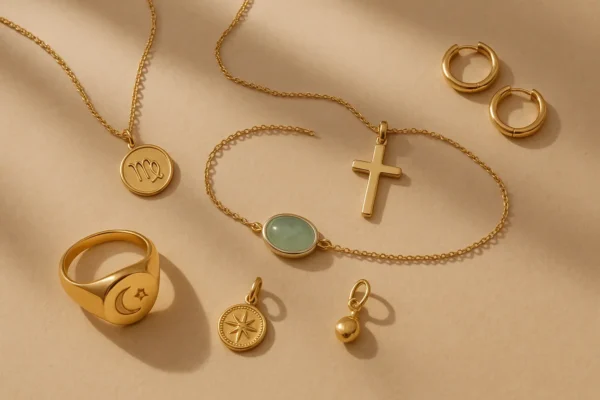
For Rochas Jewelry’s intention-minded shoppers, that combination offers a practical way to bring personal meaning into daily wear. A celestial motif or birthstone can represent something important to you, while its surface or moving element provides a familiar point of contact.
The distinction is worth keeping clear: intentional jewelry can be a personal grounding cue, but it isn’t a treatment for anxiety. There’s no need to attach a health promise to it. “This reminds me to pause before I respond” is a meaningful enough purpose.
2. Check Comfort, Movement, and Fit Before the Symbolism
A piece can have a beautiful meaning and still be uncomfortable by lunchtime. Before choosing by zodiac sign, color, or intention, look at how the jewelry will actually feel and function.
Comfort comes first. Look for smooth edges, a comfortable underside, and moving parts that won’t pinch skin or catch hair. Raised settings and sharp decorative points may look striking, but they can become annoying against a keyboard, sweater cuff, or bag strap.
For rings, consider the width as well as the size. A wide band can feel tighter than a narrow one in the same stated size. For necklaces and bracelets, think about weight and whether the piece will repeatedly knock against your chest or desk.
Movement should feel easy, not distracting. Different designs offer different experiences:
- A rotating band provides a repeated circular motion.
- A sliding bead gives your fingers a short path to follow.
- A textured surface offers tactile interest without moving parts.
- An articulated pendant adds movement, though it may be more noticeable or audible.
If discretion matters, ask whether the mechanism clicks, rattles, or squeaks. A product video can help you understand how it moves, though it won’t necessarily reveal how loud it sounds in a quiet room. Check reviews for comments about noise, snagging, and long-term wear—not just appearance.
Fit should support gentle use. A ring should feel secure without squeezing and come off without excessive effort. Measure according to the seller’s guide, ideally more than once, since finger size can fluctuate throughout the day. A bracelet needs enough room to move comfortably without sliding into your work constantly.
For a necklace, choose a length that lets you reach the tactile feature naturally. If you have to tug on the chain to use it, the design may not suit your routine.
Before buying, check the return policy. Comfort and movement are personal, and even detailed measurements can’t tell you everything.
3. Match the Piece to Your Real Day
The best everyday jewelry fits the moments you already have—not an imagined routine that requires constant adjustment.
For meetings: A low-profile ring or a smooth pendant may be easier to use subtly than a loose charm bracelet. Test whether you can touch or move the feature with one hand, without looking down. Also consider sound: something barely noticeable at home can become distracting beside a conference-room microphone.
For desk work: Pay attention to contact points. Does a ring press into your finger while typing? Does a bracelet tap against your laptop? A comfortable piece should let you switch between touching it and working without repeatedly taking it off.
For commutes: Favor secure closures and shapes that won’t snag on coats or bags. Use tactile jewelry only when it’s safe to do so, such as while seated on public transport—not when driving, cycling, or navigating a crowded crossing.
For understated styling: Start with one tactile piece and keep the surrounding jewelry simple. A softly finished band can sit alongside plain studs; a small symbolic pendant can work with an open collar or a simple knit. Matching every metal isn’t necessary, but a restrained mix can keep the overall look cohesive.
Rochas Jewelry’s celestial and symbolic direction lends itself to this personal approach. You might choose a birthstone to mark a family connection or an astrological motif as a reminder of a quality you want to practice. Just check the individual design: a symbolic piece isn’t automatically a fidget piece, and a moving decorative element isn’t necessarily built for repeated handling.
You can also give the piece a simple cue: touch the texture, notice where you are, and decide what needs your attention next. If that feels useful, keep it. If it becomes distracting, there’s no obligation to make it a ritual.
4. Care for the Finish—and the Moving Parts
Frequently handled jewelry experiences more friction than a piece you rarely touch. That makes material details especially important.
For gold-plated jewelry, remember that the gold is a surface layer over another metal. Repeated rubbing can gradually wear that layer away, particularly along edges and contact points. A higher karat description tells you about the gold’s composition, not how thick the plating is or how long it will last.
Before buying, look for the base metal, plating details, and care instructions. To help preserve the finish:
- Remove the piece before swimming, showering, exercising, or cleaning.
- Let lotions, perfume, and hand sanitizer dry before putting it on.
- Gently wipe it with a soft, nonabrasive cloth after wear.
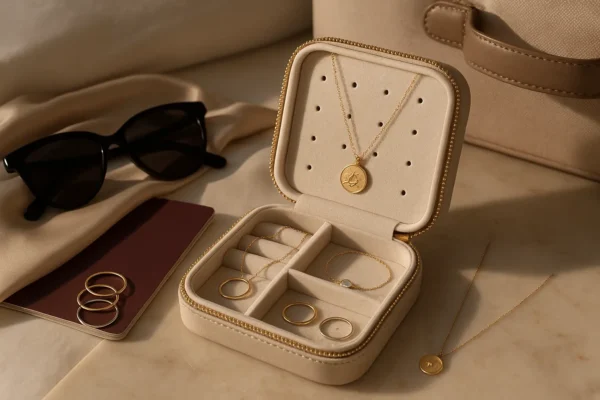
- Store it separately to limit scratches.
- Avoid abrasive polish, harsh cleaners, and vigorous rubbing.
If you want a piece for frequent tactile use, ask whether the plating covers the moving contact surfaces and whether replating or replacement support is available.
For stainless steel, durability is a useful advantage, but it isn’t a promise of indestructibility. Uncoated stainless-steel pieces are generally resistant to corrosion and relatively easy to maintain. When the maker’s instructions allow, clean them with mild soap and lukewarm water, then rinse and dry thoroughly.
Gold-colored or gold-plated stainless steel needs care appropriate to its coating, not just its steel base. Also, 316L stainless steel commonly contains nickel; labels such as “medical-grade” don’t guarantee that everyone with a metal sensitivity will tolerate it.
For any moving design, inspect it occasionally for loose components, rough spots, or trapped residue. Don’t force a stuck mechanism or add household oil unless the manufacturer specifically recommends it. Pieces with stones, adhesives, or delicate finishes may need different cleaning methods.
The most worthwhile choice isn’t necessarily the most elaborate one. It’s the piece that feels comfortable, moves the way you like, fits your daily style, and comes with clear material and care information. Personal meaning can make it special; practical design makes it something you’ll actually wear.