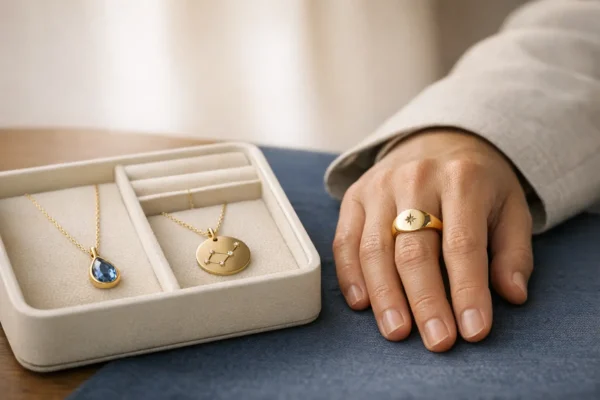
You’re listening on a video call, thinking through a tricky email, or waiting for your turn to speak. Your hands want something to do—but clicking a pen isn’t exactly winning you points with the people nearby.
That’s where discreet fidget jewelry can fit into the workday. Think of a ring with a rotating outer band, a pendant with a movable element, or a bracelet with a smooth bead you can gently roll between your fingers. The idea is simple: a piece that looks like everyday jewelry while offering a small, tactile interaction.
For value-conscious self-care advocates, that combination makes sense. Instead of buying another desk accessory, you can choose something you enjoy wearing that also serves as a personal reminder to pause.
It fits the quiet-luxury approach, too. You don’t need a visible logo, an oversized gemstone, or a whole stack of accessories. A thoughtfully chosen piece with a comfortable shape and an understated finish can feel polished without demanding attention.
The important distinction? Fidget jewelry is an accessory, not a treatment for anxiety. Its role can be as modest as reminding you to take a breath before replying to a message. You don’t need to give it a bigger job than that.
2. Start With Fit, Feel, and Movement
A piece can look perfect online and still feel distracting after an hour at your desk. When shopping for jewelry you’ll touch repeatedly, comfort deserves more attention than the product photo.
Choose a fit that stays comfortable during ordinary tasks. A ring should feel secure without pinching and come off without a struggle. Your fingers may change size slightly throughout the day, so use the seller’s sizing guide rather than guessing. Wide bands can feel tighter than narrow ones, even at the same listed size.
For bracelets, check whether the clasp or beads sit directly beneath your wrist while typing. A lovely bracelet can become less lovely when it presses against a laptop all afternoon.
Look for rounded edges and well-finished surfaces. Pay attention to the inside of a ring, the underside of a pendant, and any area your fingertips will repeatedly touch. Rough joins, sharp settings, or exposed moving parts can irritate skin or catch on clothing.
Check how the movement actually works. “Fidget-friendly” can describe very different designs. Some rotate; others slide or roll. Look for product videos and reviews that discuss:
- Whether the movement is smooth or catches.
- Whether the piece clicks, rattles, or squeaks.
- Whether using it requires one hand or two.
- Whether moving parts snag hair or pinch skin.
A silent-looking product photo tells you nothing about sound. If discretion matters, ask the seller directly.
Read the material description carefully. Gold plating is a surface layer, not solid gold, and it can wear with friction and use. Moving components deserve particular attention because they repeatedly rub against one another.
Rochas Jewelry’s material approach includes options such as recycled 18K gold plating and 316L stainless steel. Check the specifications for the individual piece rather than assuming every design uses the same construction. Also, 316L stainless steel can contain nickel; the term “medical-grade” isn’t a guarantee that it will suit every person with a metal sensitivity.
Finally, review care instructions, return terms, and any warranty covering moving parts. A sensible return policy is especially useful when comfort is hard to judge through a screen.
3. Keep the Styling—and the Interaction—Office-Friendly
The best work accessory fits your routine as well as your outfit.
If you type for most of the day, a low-profile ring may be more practical than a loose bracelet. If rings get in your way, a smooth pendant could offer an occasional tactile touchpoint instead. Neither needs a dedicated mechanism to be meaningful; sometimes a simple, comfortable surface is enough.
For a quiet-luxury look, start with one piece in a finish you already wear. A slim gold-tone band, a brushed silver-tone ring, or a small celestial pendant can sit comfortably alongside workwear without making your accessories the focus.
Symbolism can stay subtle, too. A zodiac engraving or birthstone accent can carry personal meaning without requiring an explanation at the Monday meeting. Rochas Jewelry’s emphasis on celestial and intention-driven designs lends itself to that approach: choose a symbol because it resonates with you, not because it promises a particular outcome.
Before making a piece your everyday office companion, give it a practical test:
- Type for a few minutes. Does it tap against the keyboard or press into your hand?
- Handle your usual belongings. Does it catch on a sleeve, bag strap, or notebook?
- Try the movement in a quiet room. Is it genuinely unobtrusive?
- Notice the visual distraction. Does using it involve large or repeated gestures?
Discreet means considerate, not hidden at all costs. If an interaction is noisy during a meeting, save it for a break. And if your workplace restricts jewelry around machinery, clinical tasks, or food handling, those rules come first.
4. Build a Small Pause Into Your Day
A jewelry-based grounding ritual doesn’t have to involve elaborate steps or spiritual language. Here, “grounding” simply means briefly noticing a physical sensation and returning your attention to what you’re doing.
Try this between tasks:
- Touch the piece. Notice its texture, temperature, or shape.
- Make one gentle movement. Turn the band once or trace a smooth edge.
- Take an easy breath. There’s no need to force a breathing pattern.
- Choose your next action. Finish one paragraph, ask one question, or step away for your scheduled break.
That’s it. The jewelry is a cue, not the thing doing the work for you.
If intention-setting appeals to you, give the piece a straightforward meaning: “Pause before responding,” “One task at a time,” or “I can take my break.” A celestial motif can represent that intention without being presented as a source of healing, protection, or career success.
Keep the ritual optional. You don’t need to repeat it perfectly or use it in every uncomfortable moment. If the movement distracts you, feels irritating, or makes it harder to focus, stop and choose another kind of pause.
And while some people enjoy tactile accessories, experiences vary. Jewelry isn’t a substitute for professional support when anxiety is persistent or interfering with daily life.
5. Buy for Everyday Value, Not Big Promises
Accessible luxury works best when “accessible” includes both the price and the practicality. A bargain isn’t much of a bargain if the ring pinches, the mechanism sticks, or you leave it in a drawer.
Before buying, ask yourself three questions: Will I wear it? Will I enjoy touching it? Can I care for it realistically?
Prioritize clear material information, comfortable proportions, reliable movement, and useful after-sales support. Read reviews about long-term wear—not just first impressions—and look for details about noise, finish durability, and sizing.
If sustainability is part of your decision, look for specific information about recycled content and how environmental claims are supported. Durability and repair options matter alongside the initial material choice. One versatile piece you use regularly may be a better personal purchase than several trend-led accessories you rarely reach for.
When browsing Rochas Jewelry or any other collection, don’t assume that every symbolic ring or celestial pendant is designed for fidgeting. Confirm the mechanism if you want moving parts. If you simply want a tactile reminder, a smooth, well-fitting piece may be all you need.
The goal isn’t to accessorize your way into perfect productivity. It’s to find something that suits your style, respects your budget, and gives busy hands a comfortable place to pause.