A recent jewelry launch rooted in Tibetan culture puts talismans into everyday life: familiar settings, small gestures and personal styling. Combining carved yak bone, silver, brass and natural stones, the pieces feature Dzi beads, Vajra motifs and 108-bead mala necklaces. The approach offers an interesting starting point for thinking about jewelry—not just as something you wear, but as something that reminds you how you want to live.
Maybe you’re heading into a demanding season at work. Maybe you’re building a calmer morning routine, celebrating a family milestone or trying to be more deliberate about spending. A meaningful piece can become a physical reminder of that intention.
The key word is reminder. Jewelry does not guarantee protection, wealth, career success or anxiety relief. Traditional spiritual beliefs and personal rituals can hold real significance for their practitioners without being scientifically proven effects of an object.
For Rochas Jewelry’s intention-minded community, that distinction makes choosing a talisman more personal, not less. Instead of asking, “Which necklace will bring me success?” try asking, “Which necklace will remind me to prepare, speak up and follow through?”
That’s a purpose an everyday piece can genuinely serve.
2. Give culturally specific symbols their proper context
Dzi beads, Vajra motifs and malas aren’t interchangeable “good-luck” designs. Each has its own cultural and religious associations, and understanding those differences should come before choosing one for its appearance.
Dzi beads are associated with Tibetan and Himalayan cultural traditions and are often valued as protective or auspicious objects. Commonly recognized examples are patterned agate beads. Interpretations of their patterns vary, and marketplace claims about particular designs shouldn’t be mistaken for a single, universally accepted tradition—or proof of supernatural benefits.
The Vajra, known in Tibetan as the dorje, is a ritual implement and important symbol in Vajrayana Buddhism. It carries associations with indestructibility and spiritual realization. Wearing a Vajra motif is therefore different from wearing a generic lightning-bolt charm: its meaning belongs to a living religious tradition.
A 108-bead mala is traditionally used for counting mantras or other devotional repetitions in Buddhist and other Indian-origin religious traditions. It can be worn, but reducing it to a decorative necklace overlooks its practice-based purpose. Explanations of the number 108 differ across traditions.
If one of these pieces draws you in, get curious before buying:
- Does the seller explain the symbol’s background rather than simply promise “wealth luck”?
- Who designed and made the piece?
- Are claims of Tibetan origin, artisan involvement or religious significance supported?
- Can the seller explain appropriate use and any relevant handling considerations?
Learning from Tibetan makers, practitioners and reliable cultural sources is a good place to start. Be particularly cautious about vague “ancient” or “authentic” claims attached to expensive beads.
Material context matters, too. Carved yak bone shouldn’t automatically be labeled sustainable because it is natural. Ask about its origin, animal sourcing and any applicable trade restrictions. If those details are unclear—or animal-derived materials don’t fit your values—choose a different material.
Respectful appreciation begins with recognizing that a symbol’s history extends beyond your own interpretation of it.
3. Find a meaning that fits your actual life
Your everyday talisman doesn’t need to come from a spiritual tradition. A birthstone, engraved initial, constellation or simple geometric shape can carry plenty of meaning.
Start by finishing this sentence: “When I notice this piece, I want to remember…”
Your answer might be:
- “…that steady progress matters more than rushing.”
- “…the person who encouraged me.”
- “…to pause before saying yes.”
- “…the commitment I made to myself.”
From there, choose a design that feels natural rather than one you think you’re supposed to want.
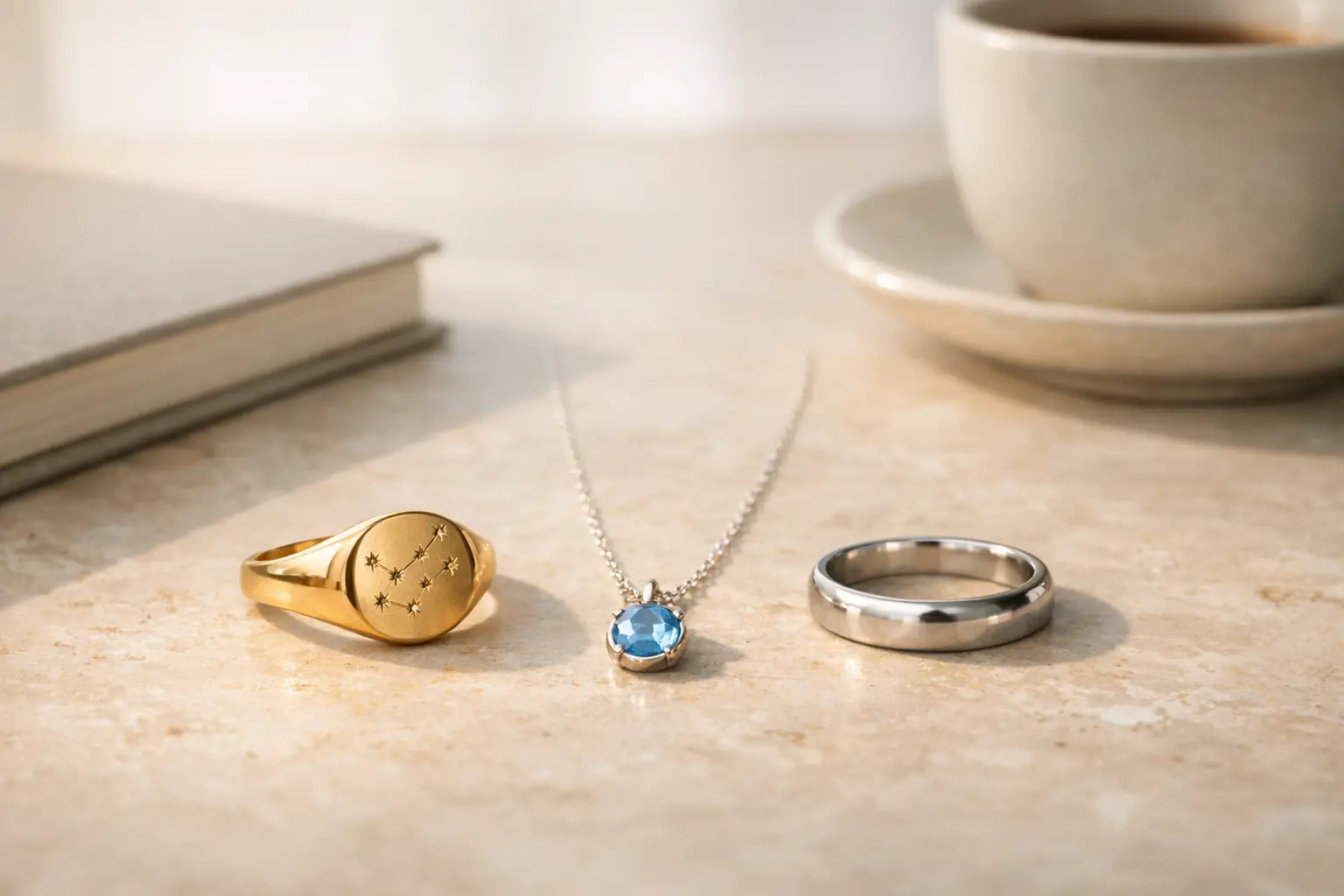
Birthstones can mark your own birthday, a child’s arrival or a loved one’s memory. Lists vary by tradition and region, so there’s room to choose thoughtfully. You can also simply love a stone’s color. A family connection doesn’t become less meaningful because you prefer one birthstone convention over another.
Zodiac designs offer another personal route. A discreet constellation pendant or amulet-style signet ring can reflect your interest in astrology without dominating your outfit. Treat astrological associations as a symbolic framework, not a scientific personality assessment or a forecast of guaranteed outcomes.
Personal symbols can be even simpler. A circle might represent continuity; an engraving might mark a turning point. You don’t need an elaborate origin story for a piece to matter.
This is a useful way to approach Rochas Jewelry’s celestial and symbolic focus: choose the design that supports your own narrative, rather than shopping for a promised result. An ambitious professional might select a ring as a reminder to negotiate confidently, but the ring itself won’t produce a promotion.
For parents, a birthstone keepsake can express love without being described as something that physically protects a child. Age-appropriate safety comes first: small components and necklaces can pose choking or strangulation hazards, especially for babies and young children. A keepsake stored for later may be the better choice.
4. Choose materials for your routine—not just the product photo
Meaning gets a piece into your jewelry box. Comfort and durability determine whether it leaves again.
Before buying, check the exact construction. “Gold,” “gold-plated” and “gold-colored” are not interchangeable descriptions. With plated jewelry, both the underlying metal and the plating thickness affect wear. Recycled gold plating describes the source of the gold layer; it doesn’t, by itself, establish the environmental impact of the whole piece.
A few everyday considerations:
- Gold-plated pieces: Friction, sweat, cosmetics and repeated water exposure can wear down the finish. Ask about care instructions and replating options.
- Sterling silver: It can tarnish, but suitable cleaning usually restores its appearance. Delicate settings still need gentle treatment.
- 316L stainless steel: It is generally durable and corrosion-resistant, but it contains nickel. Labels such as “medical-grade” don’t guarantee that everyone with metal sensitivities can wear it comfortably.
- Brass and copper: Both can develop patina and may leave temporary discoloration on skin. Decide whether you enjoy that changing finish.
- Natural stones and carved bone: Care needs vary. Porous or softer materials may be vulnerable to soaking, chemicals, scratches or impact.
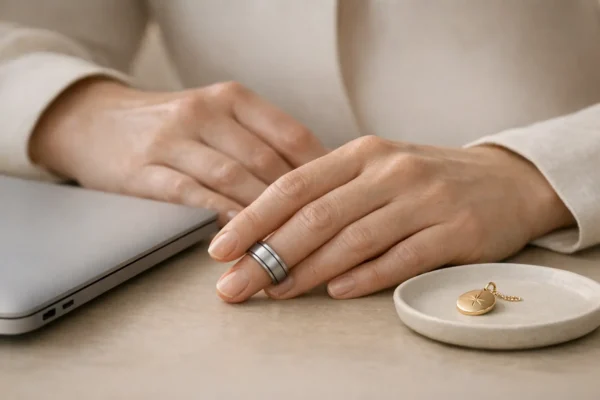
If you type all day, a smooth, low-profile ring may be more practical than a tall setting. If your work involves machinery, clinical care or food handling, check workplace jewelry rules before choosing an everyday piece.
For Rochas pieces—or any brand’s—look for item-specific material information rather than assuming every collection uses the same construction. Likewise, ask what supports sustainability claims: traceable recycled content, sourcing documentation and transparent carbon accounting are more useful than broad eco-friendly language.
Accessible luxury should still mean a purchase you can comfortably afford. Personal significance doesn’t increase with the price tag.
5. Make it part of your day, without making it responsible for your day
Styling meaningful jewelry can be wonderfully uncomplicated. Choose one anchor piece: a pendant beneath an open collar, a birthstone bracelet beside your watch or a signet ring that works with your usual clothes.
For a quiet-luxury look, keep proportions balanced and let one detail lead. You can mix metals if you like; visual harmony matters more than following a rigid rule. If you stack rings or bracelets, leave enough space to avoid constant rubbing that can damage finishes or stones.
Then build a small, realistic ritual around the piece. When you put it on, name one action you want to take:
“Today, I’ll ask the question.”
“Today, I’ll take my lunch break.”
“Today, I’ll check my budget before buying.”
Some people also enjoy touching a smooth pendant or moving a discreet fidget ring as a personal grounding cue. That preference isn’t evidence that jewelry treats anxiety, and a piece shouldn’t replace appropriate mental health support.
The best everyday talisman doesn’t have to promise extraordinary results. It can simply connect a meaningful symbol with an ordinary action—again and again.
Whether you choose a culturally grounded piece with care, a family birthstone or a Rochas celestial design, let its job be modest and personal: to remind you of what matters while you do the living.