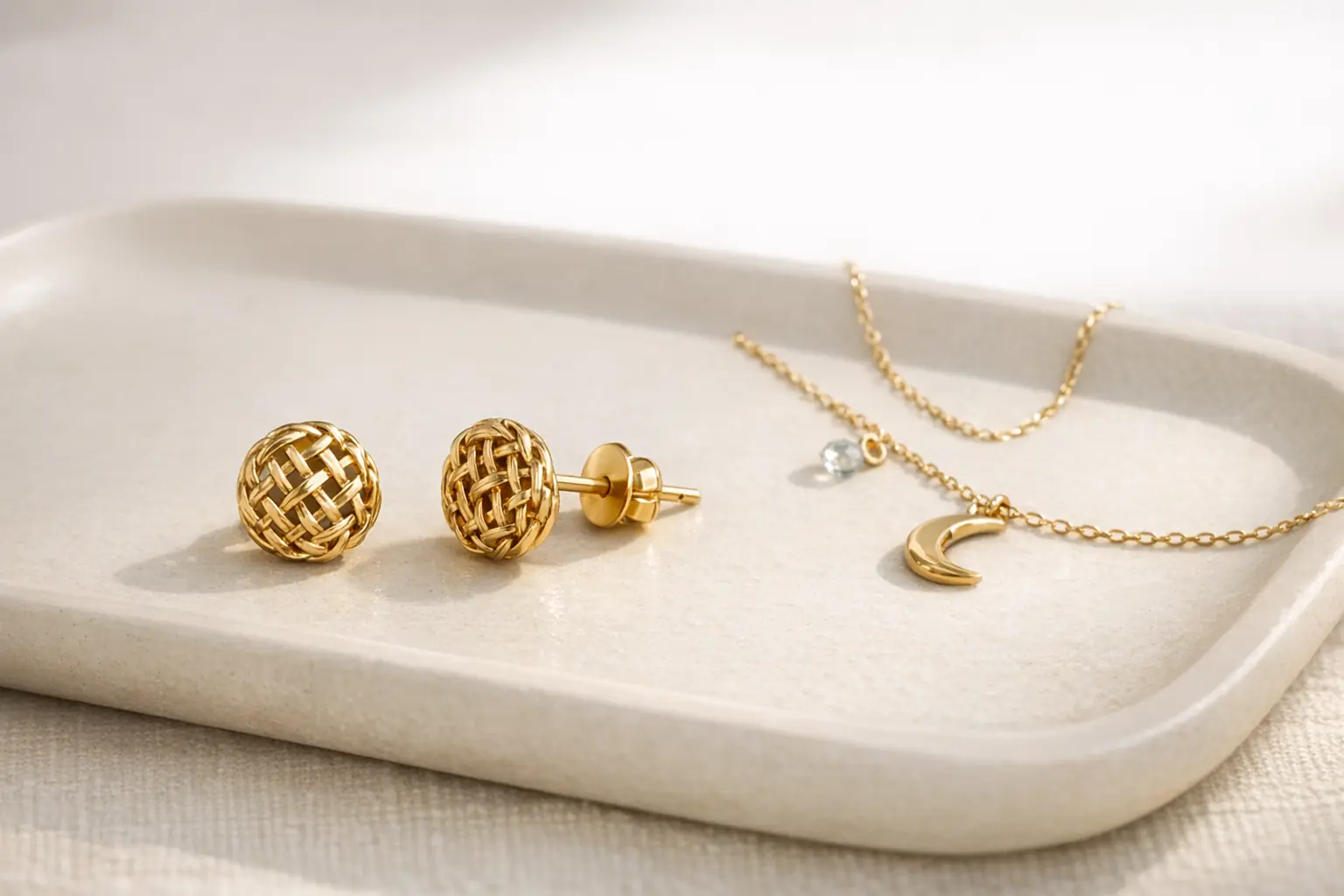
Gold-tone basket-circle stud earrings have the makings of an everyday favorite: a warm finish, an understated shape, and enough detail to feel special without dominating your look. They’re the kind of earrings you might wear to a morning meeting, keep on for lunch with friends, and pair with a meaningful pendant afterward.
But buying jewelry online means assessing more than the photos.
Take a listing that promises stock availability, five-day delivery, and secure transactions. Those are useful details, but each deserves a closer look:
- “In stock”: Is your selected finish available, or is that message a general banner?
- “Five-day delivery”: Does that mean five business days from checkout or from dispatch? Does it apply to your location?
- “Secure transactions”: Which payment methods are accepted, and what protections come with them?
Now suppose the page’s copyright notice names a different domain. That’s an inconsistency worth checking—not proof of fraud. It could reflect an old website address, a related business, or an overlooked template. It could also signal that the store’s details haven’t been carefully maintained.
The sensible response is to pause and investigate. A beautiful pair of studs should come with clear information, not a guessing game.
2. Check who’s selling—and what happens if things go wrong
Before entering your payment details, look for a consistent seller identity across the About page, contact information, terms, and privacy policy. A brand name can legitimately differ from its legal business name, but the relationship should be understandable.
If the copyright domain doesn’t match the store, ask customer service directly: “Is this domain connected to your business, and which company will process my order?” A specific, helpful answer is more reassuring than a generic promise that everything is safe.
Next, read the return policy before buying earrings. Some sellers restrict returns on pierced jewelry for hygiene reasons, especially after a seal is broken. Check:
- Whether unopened earrings can be returned.
- How long you have to request a return.
- Who pays return shipping and whether fees apply.
- What happens if an item arrives damaged, incorrect, or unlike its description.
- Where returns must be sent.
An affordable purchase can become less appealing if returning it costs almost as much as the earrings themselves.
For reviews, look beyond testimonials on the product page. Search the seller’s name and domain alongside terms such as “reviews,” “delivery,” and “refund.” Look for patterns across independent sources, especially recent feedback about material accuracy and customer service. A large five-star review count is more useful when you can tell where the reviews came from and whether they concern the product or the store overall.
Finally, choose a payment method with applicable dispute protection, such as a credit card or an eligible buyer-protection service. Rules and deadlines vary, so check the terms. Avoid letting a discount pressure you into an irreversible payment to an unfamiliar seller.
A padlock or HTTPS connection helps protect information in transit; it doesn’t establish that a seller is trustworthy. Save the listing, order confirmation, and relevant policies in case you need them later.
3. Know what “gold-tone” actually tells you
“Gold-tone” describes appearance—not gold content. A pair of gold-tone basket-circle studs may have a gold-colored coating without containing any gold at all. That can still be a perfectly reasonable choice for your budget, provided the description is clear.
Here’s how the main terms differ:
Gold-tone: A broad description of a gold-colored appearance. It doesn’t identify the coating, base metal, or expected lifespan.
Gold-plated: A layer of actual gold applied over another material. Durability depends on factors including plating thickness, the base metal, wear, and care. “18K gold-plated” describes the gold used in the surface layer—not a solid 18K gold earring.
Solid gold: Gold alloy throughout the stated component, rather than a gold layer over a different metal. Karat indicates the proportion of gold: 14K is approximately 58.3% gold, while 18K is 75%. Solid gold doesn’t have a plated layer to wear away, but it can still scratch, and its alloying metals may matter to sensitive skin.
For everyday studs, ask about the decorative front, the post, and the backing separately. They may use different materials.
Common base materials include sterling silver, stainless steel, brass, and copper. None should be hidden behind a vague phrase like “premium metal.” If the listing says 316L stainless steel, that’s useful specificity, but it doesn’t guarantee comfort for everyone with metal sensitivities. Stainless steel can contain nickel, and “hypoallergenic” isn’t a universal promise that no reaction will occur.
Also check dimensions, weight if available, and the fastening style. Close-up photography can make small studs look much larger, while a basket-style design may project farther from the ear than a flat disc.
For sensitive ears, prioritize detailed material disclosures over reassuring adjectives. If you already know which metals trigger a reaction, use that knowledge to guide your purchase.
4. Read care advice—and ask what supports the green claims
Care instructions help you understand whether a piece fits your routine. If you want earrings for frequent wear but the seller recommends avoiding water, sweat, perfume, and lotions, factor that into your decision.
For many coated or plated pieces, gentle care means putting jewelry on after skincare and fragrance, removing it before swimming, and storing it dry and separately to limit scratches. Use the seller’s material-specific cleaning advice; abrasive polishing can wear through a surface finish.
Be cautious about blanket claims such as “tarnish-free forever.” Ask what conditions apply and whether any written warranty covers finish wear.
Sustainability deserves the same practical scrutiny. For a brand such as Rochas Jewelry, whose positioning emphasizes intentional purchasing and sustainable craftsmanship, clear evidence makes those values easier to evaluate.
Look for answers to questions such as:
- What is recycled? The gold in the plating, the base metal, the packaging, or several components?
- How much is recycled? Is a percentage provided, and does it apply to this particular product?
- What supports the claim? Are supplier records, traceability information, or relevant independent certifications available?
- What does “carbon-neutral” cover? Operations, shipping, or the product’s wider lifecycle? Does the explanation distinguish emissions reductions from offsets?
Recycled gold plating doesn’t automatically mean the whole earring is recycled. Likewise, recyclable packaging doesn’t establish that the metal was responsibly sourced.
You don’t need to become a supply-chain expert to buy studs. Just favor specific, product-relevant explanations over broad green language. Choosing something you’ll wear regularly—and can care for successfully—is also a practical way to avoid disposable purchasing.
5. Make simple circles feel personal
Once the seller and materials check out, the fun part is making the earrings yours.
Understated circular studs are a versatile foundation for a symbolic jewelry collection. Their clean shape gives more expressive pieces room to stand out without making your everyday look feel busy.
Try a few easy combinations:
- For the workday: Pair gold-tone circle studs with a fine chain and a small birthstone pendant. Keep the pendant close to the neckline for a quiet, polished finish.
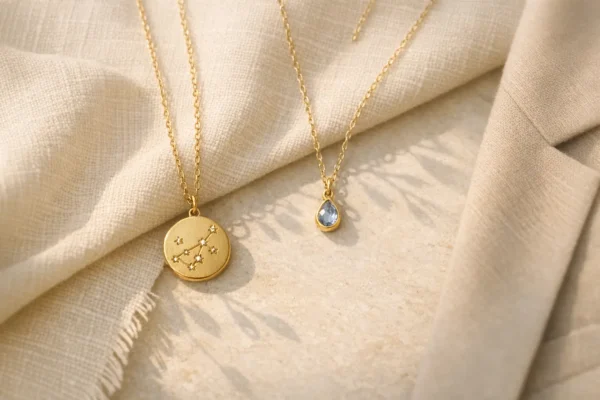
- For a celestial touch: Add a moon, star, or zodiac charm necklace. One clear motif is often enough to give simple studs a personal story.
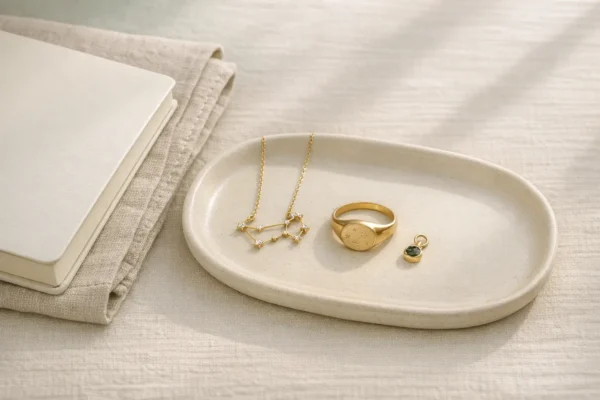
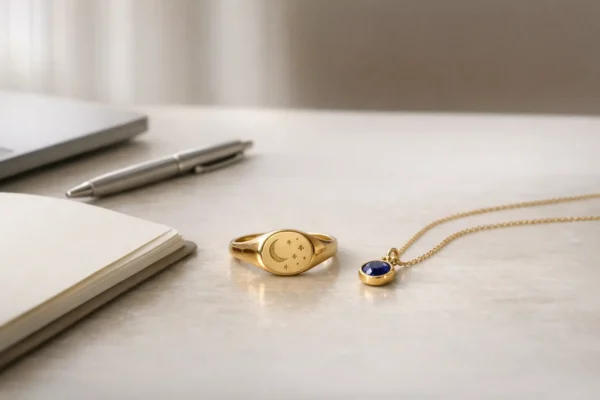
- For an intention-led look: Wear them with an amulet signet ring or a talisman you associate with courage, focus, or a new chapter.
- For relaxed layering: Combine the studs with two delicate necklaces at different lengths—one plain, one symbolic.
Matching every metal exactly isn’t necessary. Warm gold tones can sit beautifully alongside silver, especially when the mix feels deliberate and the shapes stay simple.
Birthstones and celestial motifs can serve as meaningful reminders of people, milestones, or intentions. They don’t need to promise protection, wealth, or stress relief to hold real personal value.
Whether you’re browsing Rochas Jewelry or another online store, the best everyday studs balance style with clear disclosures, realistic care expectations, and a seller you can confidently contact. Choose the meaning that speaks to you—and check the details that make the purchase feel just as good as the finished look.